Chemical rating
The Pilot Chemical Rating for drone pilots
It's the theory qualification behind every agricultural drone job in New Zealand. Here's what it is, who needs it, and how to get it.
What it is and who needs it
The CAA's guidance on drones and agrichemicals says: "Pilots must hold a Pilot Chemical Rating before they can apply agrichemicals."[1] It's one of the three things the CAA accepts as evidence that a drone pilot is trained for ag work, alongside a Part 102 pilot qualification and a UA Agricultural Rating.[1]
The rating is theory-based and valid for five years. It covers calibration, drift, nozzles, weather, NZS 8409, regulation, hazardous substances and first aid.[1] You need it before you can do the UA Agricultural Rating.[2]
Where it comes from. In the Civil Aviation Rules, the chemical rating is a Part 61 rating for manned-aircraft pilots, and Advisory Circular AC61-16 includes its syllabus.[3] Drone operators work under Part 102, which exempts them from Part 61 unless their exposition says otherwise.[4] So for drone pilots, the requirement comes through the CAA's Part 102 agricultural guidance and your operator's exposition.[1]
Growsafe and the chemical rating
Growsafe doesn't offer aerial-specific certificates for individuals. For drone crews it recommends the Growsafe Standard certificate, especially for ground crew who mix and load, because it meets the "qualified loader" requirement.[5][6] Growsafe's page suggests some Registered Chemical Applicator holders may not need the Pilot Chemical Rating, depending on regional plan rules. The CAA's newer guidance, however, says pilots must hold one, so follow the CAA.[5][1]
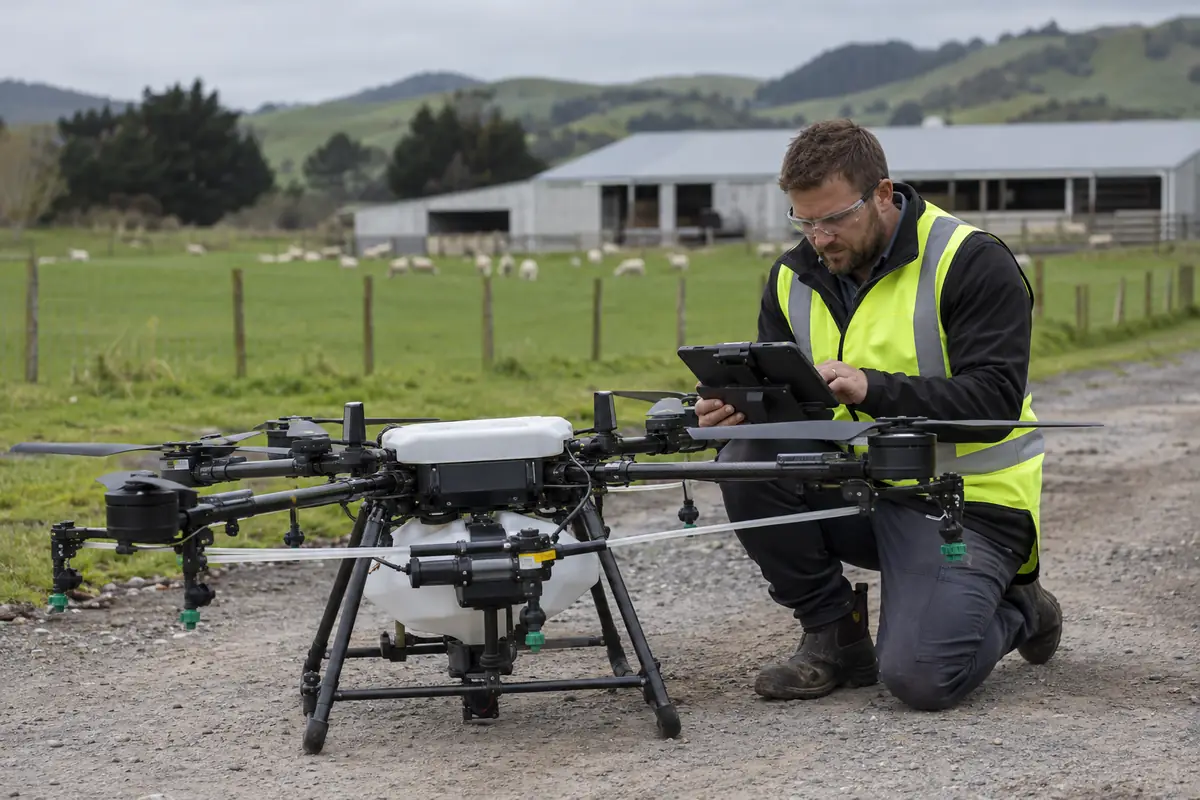
Recommended course
DroneTrust's Drone Pilot Chemical Rating
A CAA-approved, online, self-paced course. It awards the Pilot Chemical Rating - Unmanned. The details below are from DroneTrust's course page.[2]
What you get
- Ten online modules, about 14 to 18 hours in total
- Scenario-based exercises, visual interpretation tasks and a quiz in every module
- A final exam with an 80% pass mark
- Built on the Threat and Error Management (TEM) framework used across aviation
- Built to the syllabus in Appendix 1 of AC61-16 (Revision 6)
Good to know
- Price: $4,000 + GST
- Most pilots finish over one to two weeks
- Complete it within 12 months of purchase
- The rating stays valid for five years, after which you complete the course again
- It suits pilots on the Ag Pilot Pathway or Aerial Asset Management pathway, and renewals
Course outcomes
What you'll be able to do
These are the learning outcomes DroneTrust lists for its course.[2]
Risk and decisions
Apply Threat and Error Management to real chemical operations and site-specific risk assessments.
Chemicals
Classify agricultural chemicals and understand formulations, hazardous properties and adjuvants.
Application
Calibration, dispersal systems and technique, including fertiliser spreading and avoiding off-target application.
Weather and drift
Assess weather and drift conditions to make sound go or no-go decisions.
Safety
Toxicology, exposure routes, PPE, decontamination, notifications, record keeping and emergency procedures.
Rules and systems
Civil aviation rules, hazardous substances law, environmental requirements, and GNSS track logs and flight planning.
Next: where the rating fits in the pathway, total costs or the FAQ.
Ready to start your pathway?
DroneTrust, our recommended provider, can take you from your first pilot certificate to a fully rated agricultural pilot, or pick you up partway through.
Sources
Checked on 28 September 2026. Rules change, so confirm anything important with the agency concerned. This guide is general information, not legal advice.
- CAA: Operating considerations for unmanned aircraft: agrichemicals and VTA (Rev 1, 24 Oct 2025)
- DroneTrust: Drone Pilot Chemical Rating
- CAA: Advisory Circular AC61-16 (Rev 6, 5 Apr 2025)
- CAA: Civil Aviation Rules Part 102 consolidation (22 Dec 2025)
- Growsafe: Aerial and drone operators
- EPA: Hazardous Substances (Hazardous Property Controls) Notice 2017, NZ Gazette